
AviList Is Live in Bird Journal — Both World Taxonomies Up to Date
Not long ago we wrote about the road to AviList — bringing the world’s competing bird checklists into line with the new unified global standard. Today we’re delighted to say we’ve arrived: AviList 2025B is now live in the Bird Journal Library.
Nothing to do but the usual update
If you keep your records against the IOC list, this is about as painless as a taxonomy change gets. AviList steps into the place IOC held as our second world taxonomy, and the transition is a direct one — there’s nothing special to learn and nothing extra to do. You simply run the regular taxonomy update as you always would, and you come out the other side on AviList.
As ever, you’ll see a number badge on the Library button when updates are waiting. Most changes apply automatically; species splits and lumps are the ones you’ll want to look over yourself under Tools ▸ Taxonomic Updates, and our guide to taxonomy updates walks you through it if you’d like a hand.
With Clements brought current in our last release and AviList now alongside it, both of our world taxonomies are fully up to date — the first time in a good while we’ve been able to say that.
This release goes wider than the taxonomies themselves:
- Updated checklists for every region, all now built on the latest versions of both Clements and AviList, so the lists you record against stay consistent with the taxonomy behind them.
- An updated UK synonym pack, keeping familiar British names attached to the right species as the underlying taxonomy shifts.
What is AviList?
For years, birders have had to live with several competing world checklists — Clements, IOC, BirdLife and others — each making its own decisions about how species are split, lumped, named and ordered. AviList is the long-awaited effort to bring those worlds together into a single, agreed taxonomy.
First published in June 2025, it’s the work of a remarkable collaboration — Avibase, the American Ornithological Society, the Cornell Lab of Ornithology, BirdLife International and the International Ornithologists’ Union — and its current release, v2025B, recognises 11,131 bird species across 252 families. It’s free for anyone to download, published open access under a Creative Commons licence.
Two things about how AviList is built make it especially good news for Bird Journal users. It is genuinely unified, so there’s far less to reconcile between one list and the next; and each species carries a stable identifier that stays put even as names change and species split or lump around it. That lets us see exactly what has changed from one release to the next and apply it cleanly — which should make keeping current far easier for us, and more dependable for you.
If you’d like to read more about what AviList is and why it matters, these are good places to start:
- AviList — the global avian checklist — the project’s own site, with an interactive explorer.
- AviList v2025B release notes — what’s in the current version.
- Cornell Lab: a unified global checklist is now available and BirdLife International’s announcement — the story behind it.
What’s next: fewer lists, less to reconcile
With both world taxonomies current, our attention turns to the many non-world taxonomies in the Library — the regional and national lists such as BOU, ABA, AOU, SACC, CBRO, IRBC and the rest. Over time we plan to consolidate and retire these, folding each into whichever world taxonomy — Clements or AviList — represents it best. The longer-term aim is to settle on AviList as Clements aligns with it; the near-term goal is simply to collapse that long tail of separate lists into far fewer.
We know that moving off a list you’ve recorded against for years sounds daunting, so we’ve designed the migration to be as gentle as possible. Rather than starting over, your records are carried across a species at a time, with only the genuine differences — the splits and lumps that need a human eye — surfaced for you to decide. Everything else just moves.
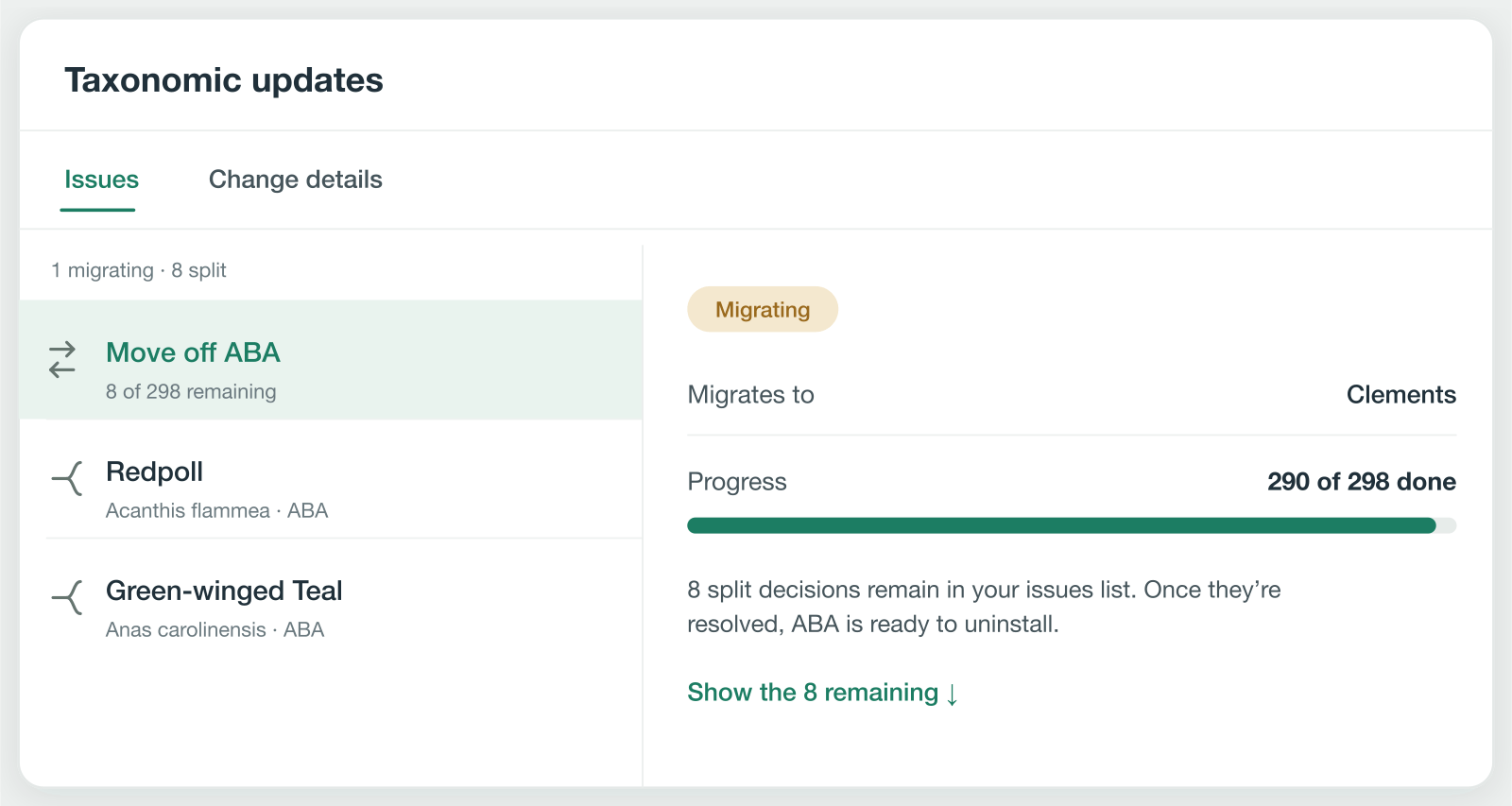
The panel above is an early look at how that will feel: the bulk of a migration completes on its own, a short list of split decisions is left for you to work through at your own pace, and once they’re resolved the old list is ready to retire. No deadlines, no lost records — just a steadily shorter list of taxonomies to keep track of.
Thank you
None of this happens without the painstaking work of the taxonomic teams behind AviList, Clements, the IOC and the regional committees, and we’re grateful for it. Thank you, too, for your continued support — do let us know how you get on with the update, and stay tuned as we begin tidying up the wider list of taxonomies.
Kingfisher photograph by Alexis Lours, used under CC BY 4.0.
